
Mannheim is charging up
Vinzent Grimmel, Head of Program Management for Smart Cities Operations at MVV, on the future of electric mobility
Reading time: 4 Minutes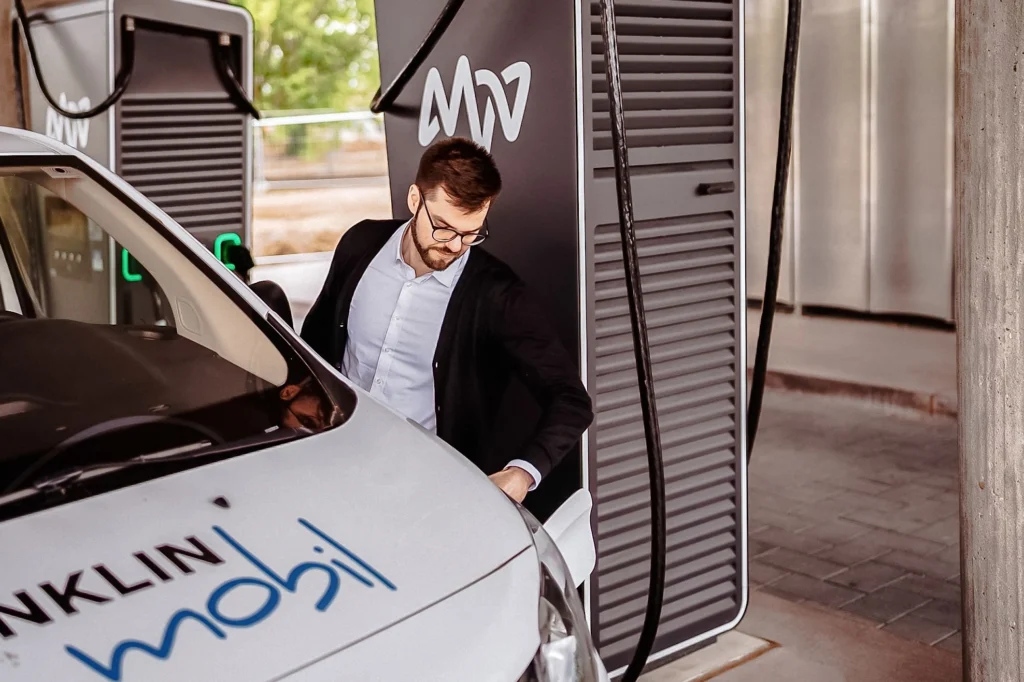
MVV Energie AG is on the path to a climate-positive future. Through its Smart Cities division, the company is focusing on the development of e-mobility. We meet Vinzent Grimmel, Head of Program Management & Operations Smart Cities, at the MVV eLadepark Columbus, a futuristic electric charging station in the Franklin neighborhood. In this interview, he explains how he and his Mannheim-based team are shaping the mobility of the future.
Ralf Laubscher
Vinzent, you’re leading the expansion of the electric vehicle charging infrastructure at MVV Energie AG in Mannheim. What is the mission?
Vinzent Grimmel
Our mission is to operate a comprehensive and climate-neutral charging infrastructure in Mannheim and the Rhine-Neckar metropolitan region. In doing so, we provide incentives for environmentally friendly and electrified private transportation.
Ralf Laubscher
With the e-car-sharing company FRANKLIN Mobil, you’re already offering a forward-looking mobility concept in the Franklin neighborhood of Mannheim. What’s the idea behind it?
Vinzent Grimmel
FRANKLIN Mobil offers a convenient and eco-friendly alternative to owning a car and helps reduce traffic and environmental impact. We have been involved in the development of the Franklin neighborhood from the very beginning. Since 2017, I have witnessed how the site has transformed from a military base into a forward-thinking residential neighborhood. It’s fascinating to see how colorful and diverse the entire neighborhood has become—a good mix of established structures and new construction projects. In this urban setting, it’s particularly exciting to rethink and redesign mobility in new and different ways.

Ralf Laubscher
How do you put that into practice with your team?
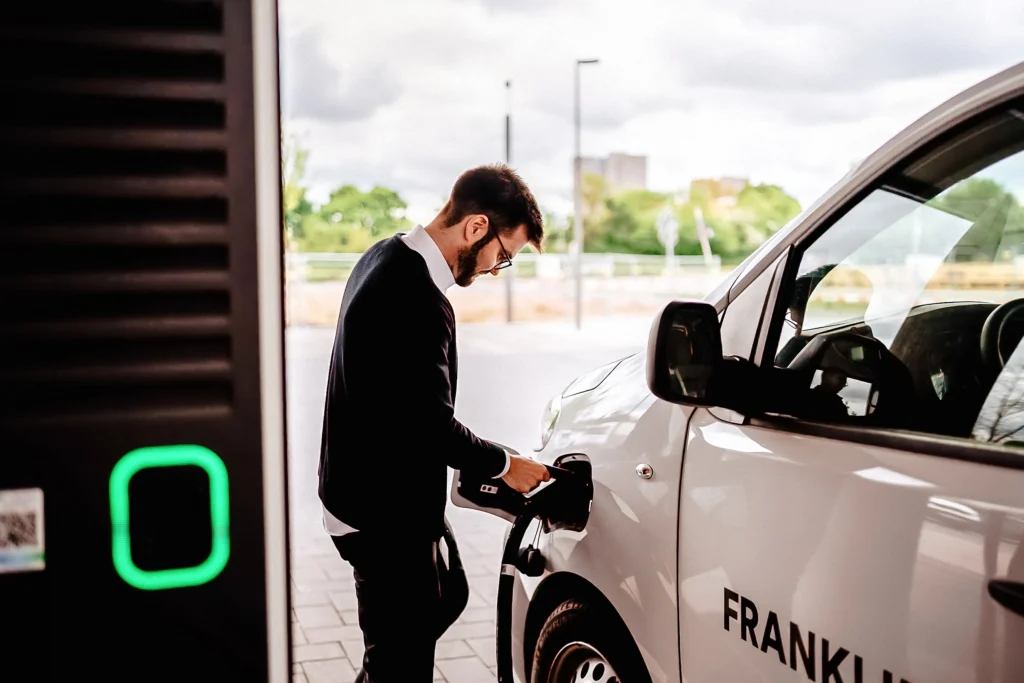
Our electric vehicles are available right next to your home. Thanks to the excellent on-site charging infrastructure, it’s very easy. You simply book a car, get in—and you’re ready to go. There’s something very liberating about that. A car-sharing vehicle can replace a primary car, but we see it primarily as an alternative to a second car.
Ralf Laubscher
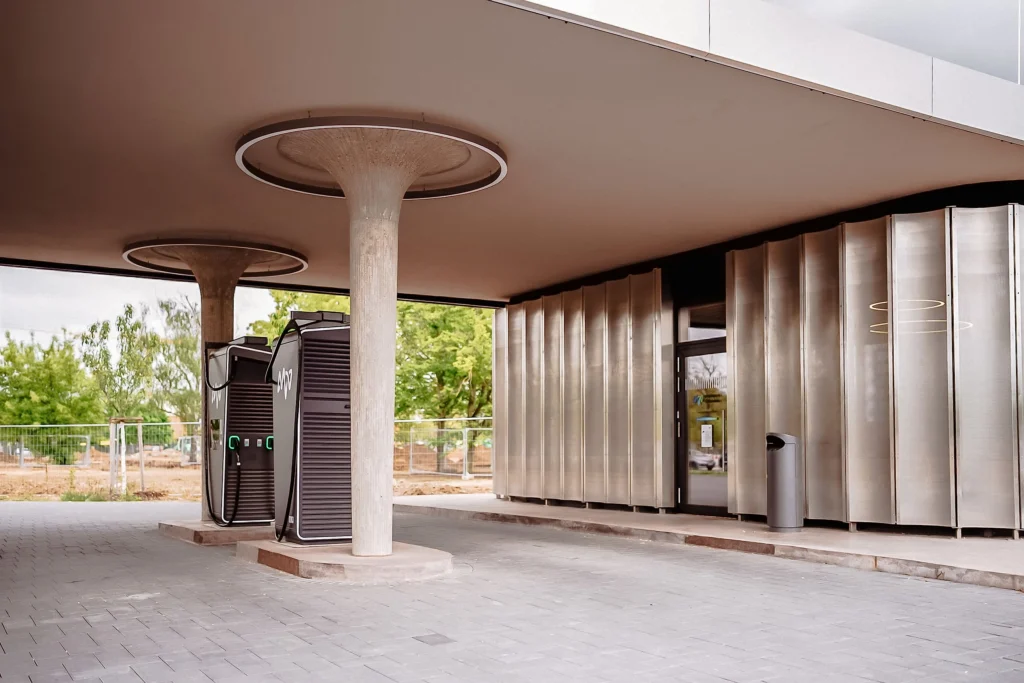
With the MVV eLadepark Columbus, you’ve created an electric charging station of the future in Mannheim that resembles a traditional gas station. Surely that’s no coincidence?
Vinzent Grimmel
No, this former U.S. gas station was converted following an architectural competition—and the design does indeed have the feel of a gas station. While you charge your vehicle’s battery at one of twelve “High Power Charging” stations, the Columbus charging station offers a comfortable lounge area. There are snacks and free Wi-Fi, and tables and chairs are available for relaxing or working.
Ralf Laubscher
How big is the team you’re working with in Mannheim on future-oriented topics?
Vinzent Grimmel
In total, up to 40 employees at MVV are working on the topic of electric mobility. We not only develop public charging infrastructure, but also offer services for commercial customers and planning services. At FRANKLIN Mobil, six people are currently working on this topic, though the majority of them are not full-time employees.
Ralf Laubscher
This work requires technical expertise. Is it difficult to find skilled workers?
Vinzent Grimmel
So far, it’s been working out pretty well for us. I think that’s partly because a sustainability issue like e-mobility motivates people to specifically apply for jobs with us. Our Mannheim Model—the implementation of the electricity and heating transitions as well as green customer solutions—is inspiring to many people. I, too, am deeply moved by this issue.
Ralf Laubscher
How would you describe the work atmosphere within the team?
Vinzent Grimmel
Very inspiring and exciting. Many members of our team live in Mannheim. What unites us is truly this sense that we’re doing something good for the city and the region. We believe in electric mobility as a key issue for the future and want to improve the quality of life for everyone—not just for car users, but also for the people who benefit from reduced noise pollution and air pollution in Mannheim and the surrounding region. We see this as a special responsibility.
Mannheim is a city that has succeeded in instilling a sense of identity in its residents. I experience a strong sense of social cohesion here. No matter where you’re from, you’re accepted and feel like you belong. I find that truly remarkable.
Ralf Laubscher
How does Mannheim compare to other cities of similar size in terms of electric vehicle charging infrastructure?
Vinzent Grimmel
Compared to cities of similar size, Mannheim is doing well in terms of electric vehicle charging infrastructure. In Heidelberg, for example, there are many charging stations, but most of them are standard alternating current (AC) stations. This means that charging speeds there are slower. Karlsruhe is currently on par with Mannheim. Other cities, on the other hand, still have significantly fewer charging options and have some catching up to do. In the Rhine-Neckar metropolitan region, where we focus our efforts, we already operate more than 160 charging locations with nearly 460 public charging points. In 2025 alone, approximately 200,000 charging sessions took place at these stations.
We are continuously expanding our network to further advance electric mobility.